
-
Rose Gold Three Stone Round Cut Diamond Engagement Ring with Pave Band
Regular price From $1,001.77 USDRegular price Sale price From $1,001.77 USDSale -
Rose Gold Three Stone Engagement Ring with Pear Side Diamonds
Regular price From $799.74 USDRegular price Sale price From $799.74 USDSale -
Rose Gold Three Stone Diamond Engagement Ring with Filigree Detail
Regular price From $634.45 USDRegular price Sale price From $634.45 USDSale -
Yellow Gold Three Stone Emerald cut Diamond Engagement Ring with Pave Band
Regular price From $974.86 USDRegular price Sale price From $974.86 USDSale -
Rose Gold Three Stone Princess Cut Diamond Engagement Ring
Regular price From $702.11 USDRegular price Sale price From $702.11 USDSale -
Rose Gold Princess Cut Three Stone Diamond Engagement Ring
Regular price From $750.32 USDRegular price Sale price From $750.32 USDSale -
White Gold Three Stone Diamond Engagement Ring with Princess Center Stone
Regular price From $854.35 USDRegular price Sale price From $854.35 USDSale -
Rose Gold Three Stone Cushion Diamond Engagement Ring
Regular price From $903.30 USDRegular price Sale price From $903.30 USDSale -
Rose Gold Three Stone Diamond Engagement Ring
Regular price From $892.75 USDRegular price Sale price From $892.75 USDSale -
Rose Gold Cushion Cut Diamond Halo Engagement Ring Band
Regular price From $1,129.89 USDRegular price Sale price From $1,129.89 USDSale -
Rose Gold Three Stone Diamond Engagement Ring with Halo and Pav Band
Regular price From $1,099.71 USDRegular price Sale price From $1,099.71 USDSale

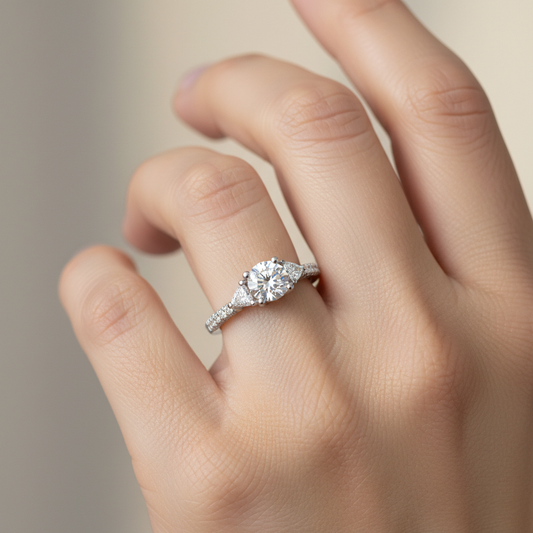

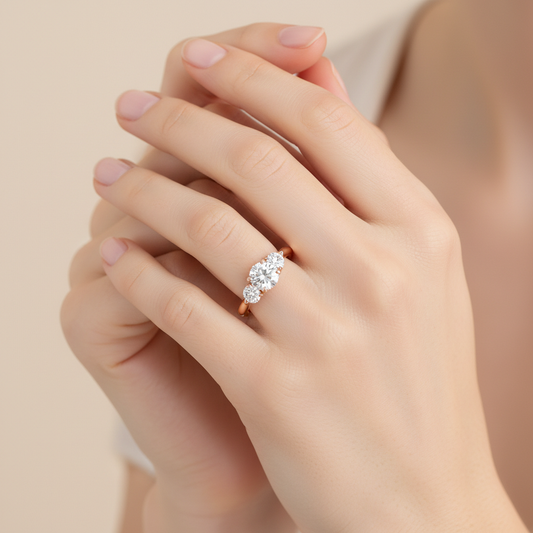

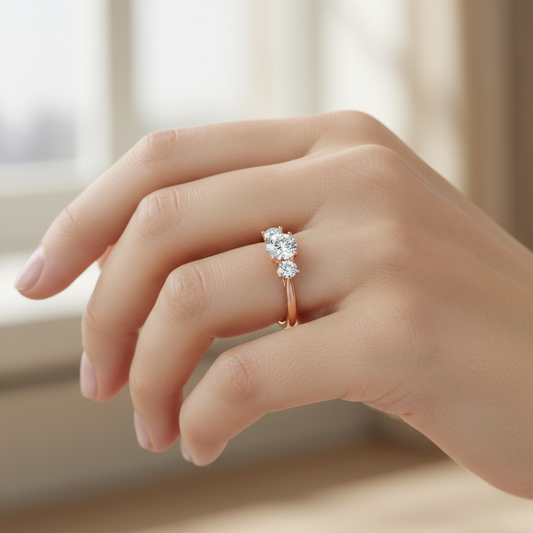

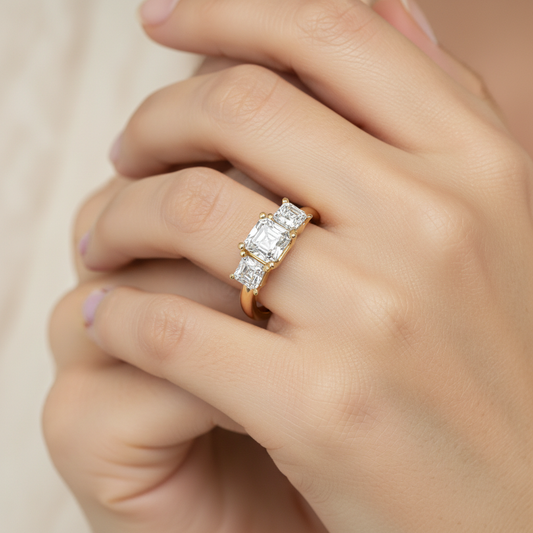

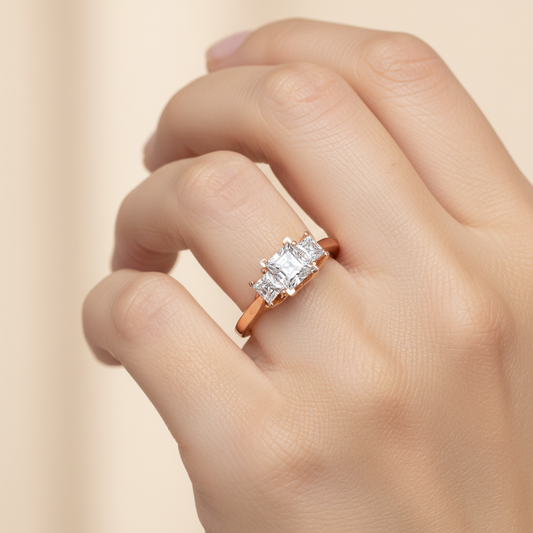

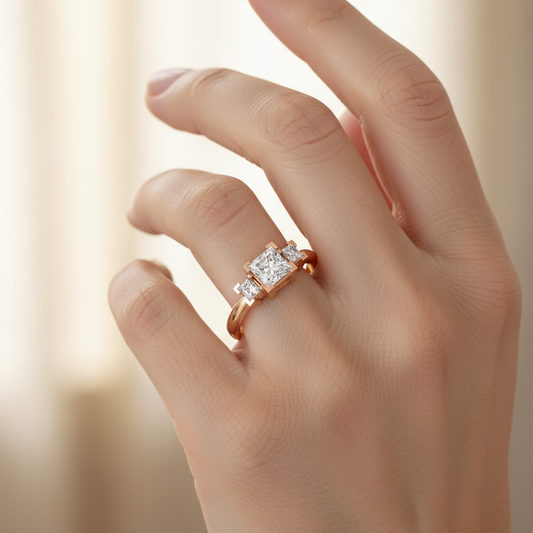

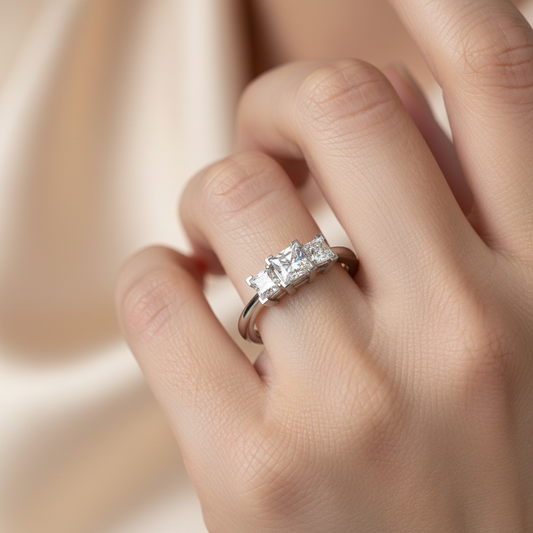


A three-stone ring sets one centre diamond between two matched side stones, traditionally read as past, present and future. It is the most chosen engagement style after the solitaire, and for a simple reason: three stones spread light across the finger in a way a single stone cannot, so the ring looks fuller than its carat weight suggests. Every ring in this collection is made to order in solid gold, available in 9K, 10K, 14K and 18K, and in yellow, white or rose gold, whichever design you start from. Diamonds are lab-grown or natural, each independently graded by IGI or GIA with a report number you can verify yourself.

Round Cut Three Stone Engagement Rings
A round cut three stone engagement ring is the most classic reading of the style, a round brilliant centre flanked by two round sides, with a band of pavé diamonds carrying the sparkle down toward the shank. Round remains the most forgiving choice because it pairs with almost any side stone shape and hides slight variations in colour better than step cuts do. If you want a ring that will still look right in thirty years rather than one tied to a moment, this is where most people land. It is our largest group of designs and available in all three gold colours.
Princess Cut Three Stone Engagement Rings
A princess cut three stone engagement ring gives the design a squared, geometric line that reads sharper and more modern than a round centre. Princess cuts hold their carat weight in a compact footprint, so they cover the finger well without sitting tall. The flat edges are also what make them so easy to pair, because a straight-edged side stone can be set flush against them with almost no gap. That single detail is why Princess and Trillion are considered one of the strongest pairings in three-stone design, and we make both.
Three Stone Rings with Trillion Side Stones
A three stone ring with trillion side stones uses triangular side stones, and they do something no round side stone can. A trillion has a wide flat table, which makes it look noticeably larger than its actual carat weight, and its straight edge sits cleanly against a princess or radiant centre without a visible break. The result is a ring that spreads wider on the finger for the same weight of diamond. Trillions read contemporary rather than traditional, so they suit anyone who wants the meaning of a three stone ring without the expected look of one.

Three Stone Rings with Baguette Side Stones
A three stone ring with baguette side stones pairs a brilliant cut centre with long, rectangular step cut sides. Baguettes behave completely differently from brilliant cuts. Instead of scattering light in all directions they throw clean, broad flashes, which gives the ring an architectural, Art Deco quality. Tapered baguettes narrow toward the band and create a smooth visual transition from the centre stone down to the shank, drawing the eye inward rather than competing with the main diamond. If you like clean lines over maximum sparkle, this is the pairing to look at.
How to Choose Side Stone Shape and Proportion
Most guidance on side stones lives in blog posts rather than next to the rings themselves, so here is the short version while you are actually looking. Proportion matters more than shape. Side stones generally sit between fifty and sixty-five per cent of the centre stone's diameter; go smaller and the ring reads as a solitaire with accents, go larger and the eye stops knowing where to settle. On shape, match for a calm and cohesive look, mix for something that feels custom. Round sides suit almost any centre. Trillions and trapezoids pair best with squared centres like princess and radiant. Baguettes belong with step cut and geometric centres. Pear-shaped sides taper the eye inward and work beautifully with oval and round centres. Because every ring here is made after you order it, none of these pairings is fixed.

Rose Gold, White Gold and Yellow Gold Three Stone Rings
Metal colour changes a three stone ring more than most buyers expect, because there are three stones catching the tone of the metal rather than one. Our yellow gold three stone diamond engagement ring carries the warmest, most traditional feel and flatters warm skin tones. White gold makes diamonds read brighter and cooler and is rhodium plated for that bright finish. Rose gold sits between the two and holds its colour without plating, since the tone comes from copper in the alloy. Every design in this collection can be made in any of the three, so the name of a ring is a starting point rather than a limit.
Halo, Pave Band and Filigree Detail
Detail is what separates two rings with the same three stones. A three stone halo design wraps the centre stone in a ring of smaller diamonds and continues them along the band, which makes the centre appear larger and lifts the whole ring's brightness. A plain pave band does the same job more quietly, keeping the focus on the three main stones while still carrying light down the shank. For something with age to it, a filigree three stone ring uses openwork metal along the gallery, a technique closer to hand finishing than machine setting, and it gives the ring a vintage character that a modern setting cannot fake.
Gold Karat and Diamond Choices
Every design is made in 9K, 10K, 14K or 18K gold. Lower karats are harder and more scratch resistant, which matters on a ring worn daily for decades. Higher karats carry more gold and a deeper colour. On stones, you can choose lab-grown or natural diamonds. Both are real diamonds and identical on the finger; the difference is cost, and because a three stone ring uses three stones rather than one, choosing lab-grown saves noticeably more here than it would on a solitaire. Whichever you choose, each diamond is independently graded by IGI or GIA and comes with a report number and verification access. Sizes run from 3 to 8.5.

Made and Tested in Our Own Workshop
Jebij has manufactured fine jewellery since 1970 and is run today by the fourth generation of the family. We are not a reseller. Every ring here is cast, set and finished under our own roof, then put through a documented quality control process before it ships. Stone grading is checked against the certificate, every prong and bezel is inspected under magnification, the setting is tested for movement, and the finished ring is measured against its specification. Matching stones is the hardest part of a three stone ring. Three diamonds must agree on colour and cut or the eye catches the mismatch immediately, and that is far easier to control when the same workshop selects and sets all three rather than buying them in separately.
Custom Three Stone Rings Made to Order
Nothing here is fixed. Because every ring is made after you order it, you can change the centre stone size, ask for a side stone shape we do not currently show, move a design into a different gold colour or karat, or start from a reference image and have something built from scratch. Pear, oval and marquise side stones are all possible even where they are not listed. Send us what you have in mind through our custom three stone ring service and we will quote it before any metal is cut.
Explore Other Collections
-

Solid Gold Stud Earrings with Lab Grown Diamonds
Jebij stud earrings are made in solid gold in 9K, 10K, 14K...
-

925 Sterling Silver Pendants
Sterling silver is the easy way into fine jewellery, and a pendant...
-

Anniversary Rings
Best Anniversary Rings for Her The best anniversary rings for her special...


